Tell us about the job
Takes about a minute. No obligation.
The reversing valve and refrigerant circuit in a heat pump here do not get the long idle that equipment in shorter-season climates gets. Homes in Chittenden County, VT run heat about nine months a year, from September through May. Cold outdoor air pushes a heat pump toward the lower edge of its operating range, which loads the compressor harder than a milder winter would, and that sustained strain shows up in the refrigerant circuit first. A contractor diagnosing a fault in this county checks refrigerant charge, valve function, and coil condition before anything else, because those are the components that have been working since September.
Stock built to carry one generation of equipment and then adapted for the next tends to wear its history inside the equipment itself, not in the walls or the crawlspace. Half the homes in Chittenden County, Vermont were built in 1981 or earlier (2020-2024 ACS 5-year). A heat pump running in a house that old has likely outlasted whatever preceded it, and the wear a contractor finds when the unit comes open reflects that service record: refrigerant condition, contactor pitting, capacitor degradation, coil fouling. Those are the variables that decide the repair scope and the parts bill. The house is rarely where the answer is.
The Parts of a Heat Pump a Contractor Checks During Repair
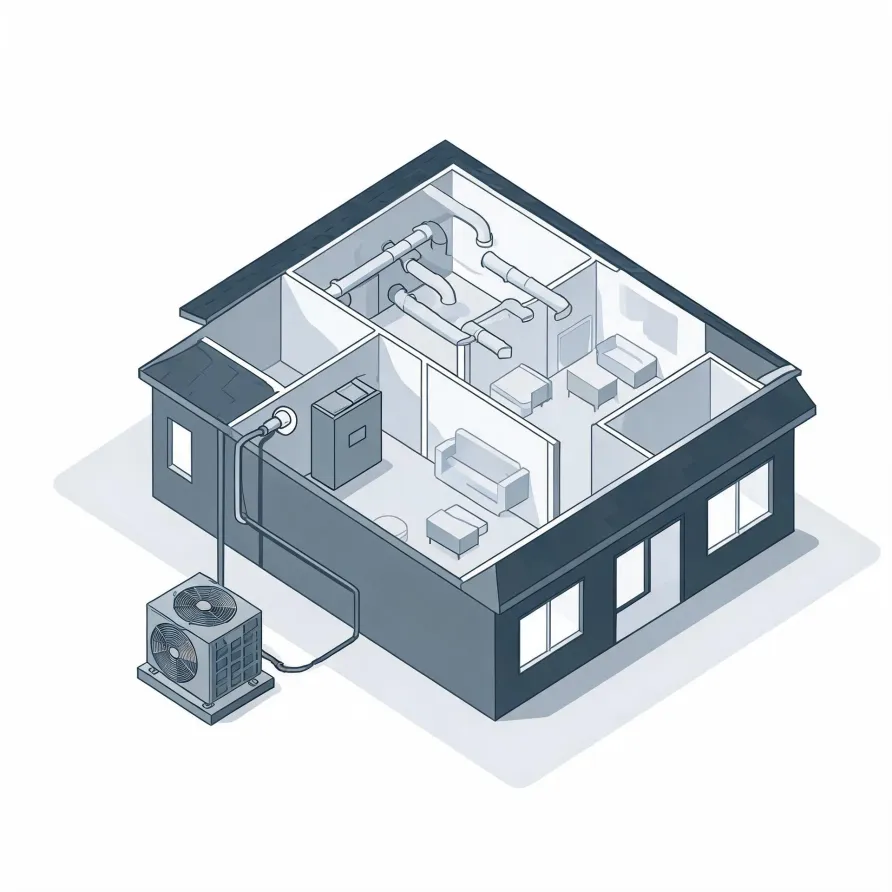
The outdoor unit is usually where a contractor starts. It houses the compressor and the condenser coil, and it sits outside the house on a pad or bracket. When this unit is the problem, symptoms show up as a system that runs but moves little heat, or one that does not run at all. The indoor air handler, mounted inside the house, holds the evaporator coil and the blower fan that pushes conditioned air through the home.
The refrigerant lines connect the two units and carry the working fluid between them. The expansion valve, which sits inside and regulates how refrigerant enters the evaporator coil, is another piece a contractor examines when the system is underperforming. The thermostat and the control boards that sit with each unit are also part of what gets checked, since electrical faults there can mimic mechanical failures.
The drawing shows a representative layout, and a licensed contractor determines exactly which components apply to your system.
Find a contractor in Chittenden CountyChittenden County, by the numbers
196 severe weather events were recorded in Chittenden County, Vermont between 2015 and 2024.
NOAA National Centers for Environmental Information, Storm Events Database, bulk CSV export, events 2015-01-01 through 2024-12-31.Half the homes in Chittenden County, Vermont were built in 1981 or earlier (2020-2024 ACS 5-year).
U.S. Census Bureau, 2020-2024 American Community Survey 5-Year EstimatesChittenden County, Vermont holds 74,888 housing units (2020-2024 ACS 5-year).
U.S. Census Bureau, 2020-2024 American Community Survey 5-Year EstimatesOwners occupy 63.9% of the occupied homes in Chittenden County, Vermont (2020-2024 ACS 5-year).
U.S. Census Bureau, 2020-2024 American Community Survey 5-Year EstimatesRules and Standards Behind Heat Pump Repair in Chittenden County, Vermont2 sourced rules and standards
Licensing Rules for HVAC Repair in Chittenden County, Vermont
Vermont splits the trade across two specialty licences and a contractor may hold one without the other: field A1 covers automatic gas or oil heating including geo-thermal and ground source heat pumps, and field C3 covers refrigeration or air conditioning including air-to-air heat pumps.
Vermont reaches HVAC work through its electricians’ licence rather than an HVAC licence, and the requirement stops at the front door of a house: anyone performing electrical work in Vermont must be licensed as an electrician unless the work is in a residential building containing two or fewer dwelling units.
Weather Stress on HVAC Equipment in Chittenden County
Heat pumps work against whatever the outside air throws at them, and in Vermont that workload shifts hard with the weather. Storms, temperature swings, and pressure on the system all accumulate, and a contractor who knows this county knows what that wear looks like.
196 severe weather events, 2015–2024. Source: NOAA National Centers for Environmental Information, Storm Events Database.