Tell us about the job
Takes about a minute. No obligation.
A heat pump in this county runs its heating cycle hard enough that the refrigerant circuit, the defrost board, and the reversing valve carry the real load of the season. Homes in Orleans County, VT run heat about nine months a year, from September through May. Cold outdoor air pushes the system's capacity down just when the house needs it most, so the compressor cycles more often and the defrost controls activate repeatedly to keep the outdoor coil clear. A contractor diagnosing a failed defrost board or a refrigerant charge that keeps drifting looks at total runtime and coil condition first, because those components wear in proportion to heating hours, not calendar age.
What a homeowner finds out once a repair is underway often depends less on the brand of equipment than on the service history layered inside it. Half the homes in Orleans County, Vermont were built in 1978 or earlier (2020-2024 ACS 5-year). Houses built for one generation of heating technology and then adapted to another tend to accumulate repairs, workarounds, and components that do not all belong to the same service generation. When a heat pump in stock like this is opened, a contractor is checking whether the parts it actually takes are still in production and whether previous repairs were done to the same system the current one is running on. That is what sets the scope.
The Parts of a Heat Pump a Contractor Checks First
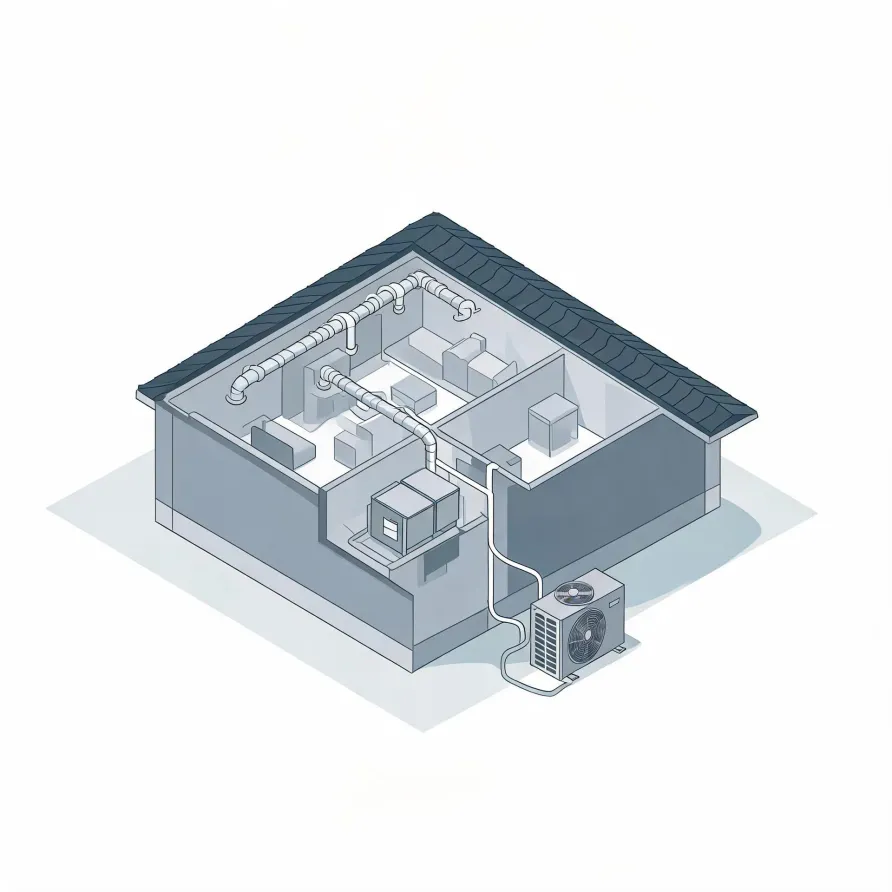
The outdoor unit sits outside the house and holds the compressor and the condenser coil. The compressor is the piece contractors go to first when a heat pump stops moving heat altogether. The condenser coil and its fan draw the contractor's attention when the unit runs but the house stays wrong.
Inside, the air handler mounts in a mechanical room, closet, or attic and pushes conditioned air through the house. The expansion valve and refrigerant lines connect the two units, and a fault in either one can look like a compressor problem until a contractor measures pressures directly. The thermostat rounds out the system as the point where wiring and control signals either work or do not.
The drawing shows a general layout of these components, and a licensed contractor determines what applies to your specific house and system.
Find a contractor in Orleans CountyOrleans County, by the numbers
87 severe weather events were recorded in Orleans County, Vermont between 2015 and 2024.
NOAA National Centers for Environmental Information, Storm Events Database, bulk CSV export, events 2015-01-01 through 2024-12-31.Half the homes in Orleans County, Vermont were built in 1978 or earlier (2020-2024 ACS 5-year).
U.S. Census Bureau, 2020-2024 American Community Survey 5-Year EstimatesOrleans County, Vermont holds 16,751 housing units (2020-2024 ACS 5-year).
U.S. Census Bureau, 2020-2024 American Community Survey 5-Year EstimatesOwners occupy 79.7% of the occupied homes in Orleans County, Vermont (2020-2024 ACS 5-year).
U.S. Census Bureau, 2020-2024 American Community Survey 5-Year EstimatesRules & Standards Governing Heat Pump Repair in Orleans County, Vermont2 sourced rules and standards
Licensing Rules for HVAC Repair in Orleans County, Vermont
Vermont splits the trade across two specialty licences and a contractor may hold one without the other: field A1 covers automatic gas or oil heating including geo-thermal and ground source heat pumps, and field C3 covers refrigeration or air conditioning including air-to-air heat pumps.
Vermont reaches HVAC work through its electricians’ licence rather than an HVAC licence, and the requirement stops at the front door of a house: anyone performing electrical work in Vermont must be licensed as an electrician unless the work is in a residential building containing two or fewer dwelling units.
Weather That Works Against Equipment in Orleans County
Heating and cooling equipment in Orleans County runs against whatever the weather puts out, and that workload accumulates over years. Repair demand is shaped by local conditions, which is why the pattern of severe weather events here is part of understanding what this service covers.
87 severe weather events, 2015–2024. Source: NOAA National Centers for Environmental Information, Storm Events Database.