Tell us about the job
Takes about a minute. No obligation.
Sizing a heat pump for this county starts with cold-weather capacity, because the equipment loses output as outdoor temperatures fall and Vermont winters push that curve hard. Homes in Washington County, VT run heat about nine months a year, from September through May. A contractor working a quote here has to calculate where the heat pump's output drops below the house's load and decide whether supplemental heat is part of the job. Ductwork, the service panel, and the building envelope all feed that calculation. An undersized system installed without that work done will run at its ceiling through the coldest weeks and wear the compressor accordingly.
Older electrical panels and ductwork laid out for furnaces are what shape a heat pump installation here, and those are decided by what the house was built with, not what it currently runs. Half the homes in Washington County, Vermont were built in 1973 or earlier (2020-2024 ACS 5-year). That puts most of the assessment work on the infrastructure rather than the new unit itself. A contractor has to check whether the existing ductwork moves air in a pattern a heat pump can use, and whether the service panel will carry the load the new equipment draws. Both of those answers come from opening the house, not from the spec sheet.
What Gets Installed With a New Heat Pump
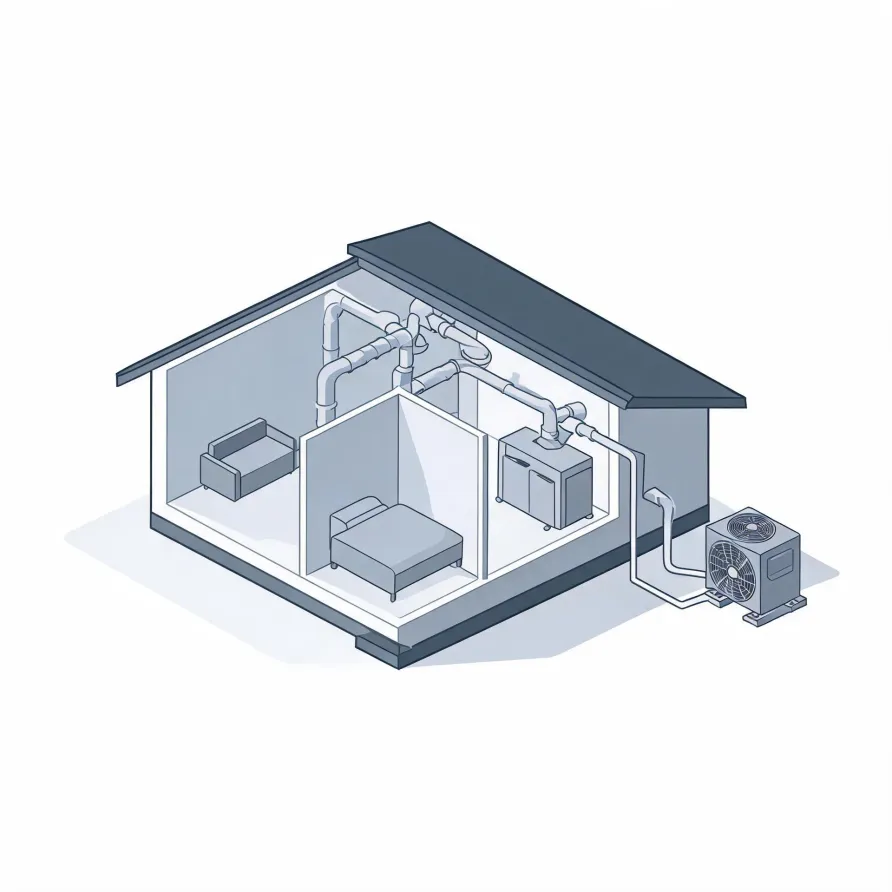
The outdoor unit sits on a pad or bracket outside the house and holds the compressor and the main coil. It is the piece a homeowner sees first and the one that does the heaviest work. Inside, one or more air handlers or wall-mounted heads deliver conditioned air directly into the living space, each one positioned in the room it serves.
A refrigerant line set runs between the outdoor unit and each indoor head, traveling through walls or along exterior surfaces to connect the two sides of the system. A condensate drain line carries moisture away from each indoor unit, and a dedicated electrical disconnect sits near the outdoor unit to allow safe service access.
The drawing shows a representative layout, and a licensed contractor determines exactly how the system is configured for your house.
Find a contractor in Washington CountyWashington County by the Numbers
113 severe weather events were recorded in Washington County, Vermont between 2015 and 2024.
NOAA National Centers for Environmental Information, Storm Events Database, bulk CSV export, events 2015-01-01 through 2024-12-31.Half the homes in Washington County, Vermont were built in 1973 or earlier (2020-2024 ACS 5-year).
U.S. Census Bureau, 2020-2024 American Community Survey 5-Year EstimatesWashington County, Vermont holds 31,004 housing units (2020-2024 ACS 5-year).
U.S. Census Bureau, 2020-2024 American Community Survey 5-Year EstimatesOwners occupy 73.7% of the occupied homes in Washington County, Vermont (2020-2024 ACS 5-year).
U.S. Census Bureau, 2020-2024 American Community Survey 5-Year EstimatesRules and Standards Governing Heat Pump Installation in Washington County, Vermont2 sourced rules and standards
What Washington County and Vermont Require for HVAC Work
Vermont splits the trade across two specialty licences and a contractor may hold one without the other: field A1 covers automatic gas or oil heating including geo-thermal and ground source heat pumps, and field C3 covers refrigeration or air conditioning including air-to-air heat pumps.
Vermont reaches HVAC work through its electricians’ licence rather than an HVAC licence, and the requirement stops at the front door of a house: anyone performing electrical work in Vermont must be licensed as an electrician unless the work is in a residential building containing two or fewer dwelling units.
Severe Weather Events in Washington County
Weather extremes set the real workload for any heat pump, and that workload shapes what equipment gets specified and how hard it runs year after year. Washington County's pattern is a local fact, and the right installation accounts for it.
113 severe weather events, 2015–2024. Source: NOAA National Centers for Environmental Information, Storm Events Database.