Profile view of a bearded man wearing a dark green baseball cap and a dark gray T-shirt against a plain light background.

Why your heat pump runs nonstop in a Vermont winter

Step 1 of 3: Equipment

A heat pump that runs nonstop in a Vermont winter is usually doing exactly what it's built to do. Below freezing, the unit has to work harder to pull heat out of the outdoor air, so the compressor stays on instead of cycling off and on like it does in milder weather. When nights drop into the teens or lower, that can mean the system runs for hours straight, or doesn't stop at all. That alone isn't a sign something's wrong. What's worth paying attention to is whether your house is actually staying warm. If rooms feel cold, if the outdoor unit is caked in ice that doesn't melt during the defrost cycle, or if the system is running constantly but losing ground, that's a sign the heat pump is struggling, not just working hard. Plenty of Vermont homes lean on oil heat alongside the heat pump for the coldest stretches, and a heat pump that can't keep pace even with backup heat running points to a real problem underneath.

A gray outdoor condenser unit on a concrete pad beside a white horizontal-siding house, with refrigerant lines and conduit running to a wall-mounted disconnect box, bare soil in front and a green shrub at left.
Running long but keeping the house warm and the coils and fins clean, this is a heat pump holding its own against the cold.
An outdoor air conditioning condenser unit on a concrete pad beside a house with light horizontal siding and a concrete block foundation, with bare soil and small green plants around it.
Caked dust across the fins blocks airflow, so the unit runs just as long but falls behind, and the house never quite catches up.

A heat pump works harder as the temperature drops, and once it's below the low 30s it loses some of its ability to pull heat out of the air. It compensates by running longer, not by running less efficiently in a way you'd necessarily notice right away. Part of that runtime is the defrost cycle. The outdoor coil picks up frost in cold, damp air, so the system briefly reverses itself, sends heat outside to melt the ice, and the outdoor fan shuts off while it does. Steam coming off the unit during this is normal. Most homes here have backup heat, usually electric resistance strips, built in to help on the coldest days. When that backup doesn't come on the way it should, the heat pump is left carrying the whole house by itself, and that shows up as runtime that never seems to end. Even the thermostat plays a part. Dial the temperature back overnight and ask for it back in the morning, and the unit can end up running long stretches just trying to catch up.

What's happening when it won't stop

  • Below about 30 to 35 degrees, a heat pump starts losing capacity, so it has to run longer to move the same amount of heat into the house.
  • Every so often the outdoor coil frosts over, and the system reverses itself into defrost mode, pulling heat from inside the house for a few minutes to melt the ice off.
  • During defrost, the outdoor fan usually stops and you may see steam rising off the unit, which is normal and not a sign of trouble.
  • Most Vermont installs pair the heat pump with electric resistance strips or backup heat that kicks in when the compressor alone can't keep up.
  • If the backup heat isn't firing when it should, the heat pump ends up carrying the whole load by itself on the coldest nights.
  • A thermostat set to recover a few degrees in the morning can make the unit run long stretches just to catch back up to temperature.
A woman in a dark gray sweater reclines on a light sofa with eyes closed and a slight smile, under a textured gray blanket with an open book resting on her lap, with a lit table lamp and plant in the background.
A smiling bearded man in a navy crewneck sweater sits at a dinner table with a glass of red wine, plates and glasses in the foreground, in a dimly lit room with a lamp and framed picture behind him.

What the outdoor air is giving up

On a 10 degree day in Vermont, outdoor air still holds heat, just far less of it than on a 35 degree day. The heat pump has to move more air across the outdoor coil to pull out the same amount of warmth, and that takes longer. A well-matched system sized for your house will run for long stretches on days like this and still keep up. That's the unit working as designed, not a sign something's wrong.


Where oil backup changes the math

Plenty of homes here pair a heat pump with an oil furnace for backup, usually set to kick in once it gets cold enough that the heat pump can't keep the house at temperature on its own. If that switchover point is set too low, the heat pump keeps grinding away on the coldest nights instead of handing off to the furnace, running longer than it should and costing more to do it given what power runs here.

A smiling man with dark curly hair in a dark green henley shirt sits on a light sofa in a living room with large windows, a lamp, shelving, a stone fireplace, and a bowl of popcorn in the foreground.
A smiling man in a dark long-sleeved henley shirt sits on a beige sofa in a living room, with a bowl of popcorn and a remote on the table in the foreground and shelves, a lamp, and a doorway behind him.
A smiling man with graying hair and stubble in a blue henley shirt sits on a gray sofa with cushions in a living room, with a bowl of popcorn on a wooden table in the foreground.
A smiling man in a dark green long-sleeve shirt reclines on a sofa in a dimly lit living room, with a bowl of popcorn on a side table in the foreground and a bookshelf, lamp, and houseplant behind him.
A single-story gray horizontal-siding house with multiple front-facing gables, white-trimmed windows, a dark front door, and a concrete walkway crossing a partly dry lawn under a clear blue sky.

Summers in Vermont don't feel heavy the way they do farther south. Homes here average a dew point of 59°F across June, July and August, based on weather data for where people actually live in the state. That's dry enough that your heat pump isn't fighting much moisture to cool the house. It pulls humidity out as a matter of course, cycles off sooner, and isn't straining the way a unit would in a sticky climate. The hard season for this equipment is winter, not summer. If yours is running nonstop right now, the cold outside is the reason, not anything left over from July. Send in the form and the search for someone qualified to look at it is no longer on you.

NASA POWER T2MDEW county cells weighted by homes

Hand off the search today

Explain the job once and skip repeating it on every call.

It costs nothing to send, and you don't have to hire anyone.

A dark bedroom with an unmade bed and pillows beside a curtained window showing rain-streaked glass and palm foliage outside.

It's early February, past ten at night. You're in the living room in a sweatshirt, and the heat pump outside hasn't shut off in an hour. You can hear it through the wall, that low steady hum that doesn't break. The thermostat says 68, which is what you set it to, but you've got a hand on the vent and the air coming out feels barely warm. Outside it's 8 degrees, the kind of cold that sits on Vermont for days this time of year. You turn the thermostat up one more degree, not sure if it'll help, and go check the breaker panel out of habit more than anything.

Is your heat pump keeping up or just running?

Put your hand near a supply vent. If the air coming out feels warm, the unit is working the way it should on a cold night, just running long to do it. If the air feels barely warm, or the house is slowly losing ground even with the thermostat set where you want it, something is off. Check the outdoor unit too. Ice building up past a normal defrost cycle, or a fan that sounds labored, means the system is struggling rather than just working hard. Left alone through a Vermont winter, a unit that's losing the fight runs up your bill without actually heating the house, and in the coldest stretches that gap between what you're paying for and what you're getting only gets wider.

  1. The thermostat calls for heat and the compressor starts pulling refrigerant through the outdoor coil.

  2. Refrigerant absorbs what little heat the cold outdoor air still holds.

  3. The compressor squeezes that refrigerant to raise its temperature before sending it inside.

  4. The indoor coil releases that heat into the air moving through your ducts.

Does a heat pump running nonstop in the cold waste a lot of electricity?

Vermont has some of the highest electric rates in the country, so watching the heat pump run for hours straight on a cold night makes you wonder what that's doing to the bill. It's a fair question, especially with oil as the usual backup here and the cost comparison always running in the back of your mind.

Running long isn't the same as running wastefully

A heat pump that runs for hours on a cold night is still moving heat more efficiently than a furnace that burns fuel to make heat from scratch. Long runtimes below freezing cost more than mild days because the unit is working harder per hour, not because it's broken. What actually drives the electric bill up is a unit that can't catch up at all, running nonstop and still losing ground, or one stuck in defrost more than it should be. Either of those points to something worth having checked, since a heat pump working the way it's supposed to, even running long, is still doing its job efficiently on a cold Vermont night.

A weathered gray outdoor condenser unit on a concrete pad beside a house with horizontal vinyl siding, with conduit, refrigerant lines, and an electrical disconnect box on the wall behind it.
Before you get your heat pump repair
A gray outdoor condenser unit on a concrete pad beside a beige vinyl-sided house, with a wall-mounted disconnect box, flexible conduit, mulch bed, shrubs and a concrete walkway in front.
After you get your heat pump repair

What auxiliary heat is actually doing

  • Auxiliary heat is a separate set of electric resistance coils, not the heat pump working any harder.
  • The thermostat brings strip heat on when the compressor alone can't close the gap between room temperature and the setpoint fast enough.
  • Those coils draw power directly, with no compressor cycle to spread the load, so they cost far more per hour to run.
  • A thermostat set back and then bumped up several degrees at once often triggers strip heat even though the heat pump itself is fine.
  • If the heat pump were sized or charged correctly, strip heat should only kick in during the coldest stretches, not every evening.
  • A contractor can check whether strip heat is firing because of a thermostat setting or because the heat pump underneath it is falling short.

Auxiliary heat, sometimes called emergency heat, is not the heat pump pushing harder. It's a separate heating element, usually a bank of electric resistance coils sitting in the air handler, that switches on when the thermostat decides the compressor can't close the gap fast enough on its own. You'll often see it marked "aux" or "em heat" right on the display. Those coils work like a giant toaster: power goes in, heat comes out, with none of the efficiency a heat pump gets from moving heat rather than making it. That's why strip heat costs more per hour to run than the compressor does, and why a few hours of it on a cold night shows up on the bill.

What triggers it matters as much as what it is. A big jump in the setpoint, say coming home and bumping the thermostat up five degrees at once, tells the system it has a lot of ground to cover quickly, and strip heat often fires to help. So does a thermostat left on a wide setback overnight. In both cases the heat pump itself may be running fine. A correctly sized, correctly charged system should lean on strip heat only during the coldest snaps of the year, not as a nightly habit. If it's coming on most evenings, something underneath it, low refrigerant charge, a struggling compressor, a unit that was undersized for the house, is making the heat pump fall short of what the thermostat is asking for. A contractor can check the thermostat settings and the heat pump's actual output to tell which one is the real cause.

Power costs 22.79 cents per kilowatt-hour statewide

At 22.79 cents per kilowatt-hour, every extra hour your heat pump runs on a cold night shows up on the bill fast. A unit that's lost capacity to dirty coils or a low refrigerant charge runs those long hours without heating the house any better, so you're paying more for less.

EIA-861 2025 statewide residential average

A closed silver laptop and a glazed ceramic mug on a wooden table, with a blurred kitchen counter, potted plant, cutting board and window in the background.

A heat pump that runs long in the cold isn't necessarily broken

Most of what runs nonstop on a cold Vermont night is just a heat pump doing its job. Below freezing, it has to work harder to pull heat from the outside air, and long run times are part of that. The difference between normal and failing shows up in what the house feels like. Warm air at the vents and a steady indoor temperature mean the system is keeping up. Weak airflow, a house that slowly loses ground, or a bill that's climbed faster than the weather explains means something inside the unit, dirty coils, a low charge, a stuck part, is making it work harder than it should.

You don't have to figure out which one it is on your own, or spend an evening calling around to find out who's even available this time of year. Once you send the form, you're done hunting for a contractor, explaining the problem over the phone to three different shops, and sorting through quotes to figure out who actually knows heat pumps in Vermont winters. Someone who repairs these systems takes it from here.

Interior corner of a dining room with a round wooden table, a ceramic vase holding olive branches, a dark spindle-back chair near a curtained window, and a sideboard with a lamp against beige walls.
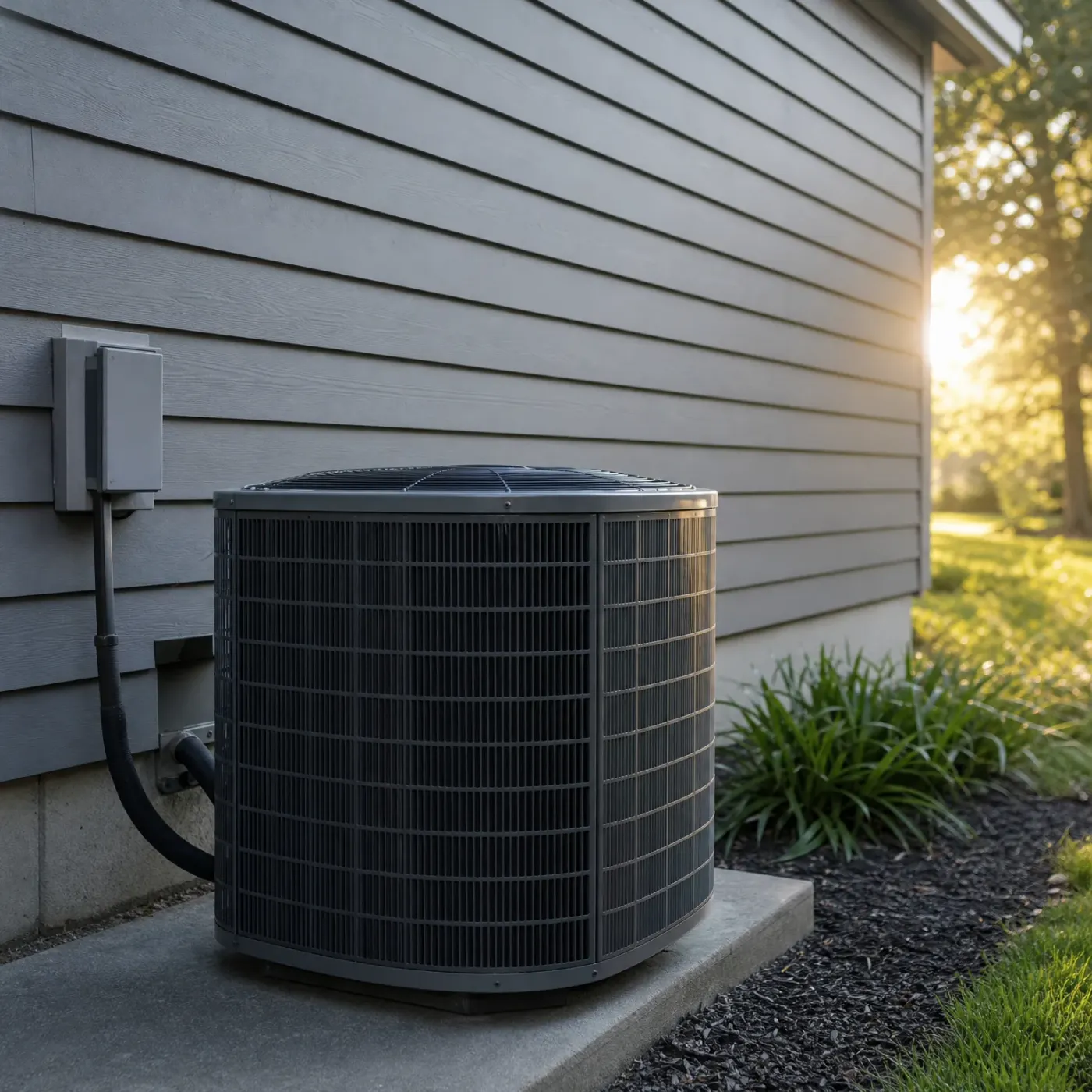
An outdoor air conditioner condenser unit on a concrete pad beside a gray horizontal-lap-sided house, with an electrical disconnect box and refrigerant line on the wall, grass, shrubs and a tree with low sun behind.

Stop chasing a heat pump pro

Answer a few questions

Skip searching for a heat pump pro and answer a few questions instead.

No charge to send it. You decide if you hire them.