Tell us about the job
Takes about a minute. No obligation.
Sizing a heat pump for Rutland County means working out what the system is being asked to do when outdoor temperatures fall hardest, because that is when a heat pump's capacity drops and the gap between what the equipment can deliver and what the house needs grows widest. Homes in Rutland County, VT run heat about nine months a year, from September through May. A contractor has to establish both the heating load the house carries on the coldest days and how much of that load the heat pump can actually cover before back-up heat becomes the system doing the real work. An undersized unit runs longer, cycles harder, and puts more hours on the compressor and refrigerant circuit across a season that leaves almost no idle time for faults to hide.
Ductwork laid in for an older heating system carries assumptions about airflow and load that a heat pump does not share, and in Rutland County that gap is the first thing a contractor has to resolve. Half the homes in Rutland County, Vermont were built in 1969 or earlier (2020-2024 ACS 5-year). Stock that old was built around equipment with different delivery requirements, so the ducts that looked adequate under the original system can restrict or misdirect airflow under a new one. Electrical service is the same story: panels sized for what a house needed then draw scrutiny before any new unit goes in. What the contractor quotes depends heavily on what the existing ductwork actually delivers when they measure it.
What a Heat Pump Installation Puts in Your Home
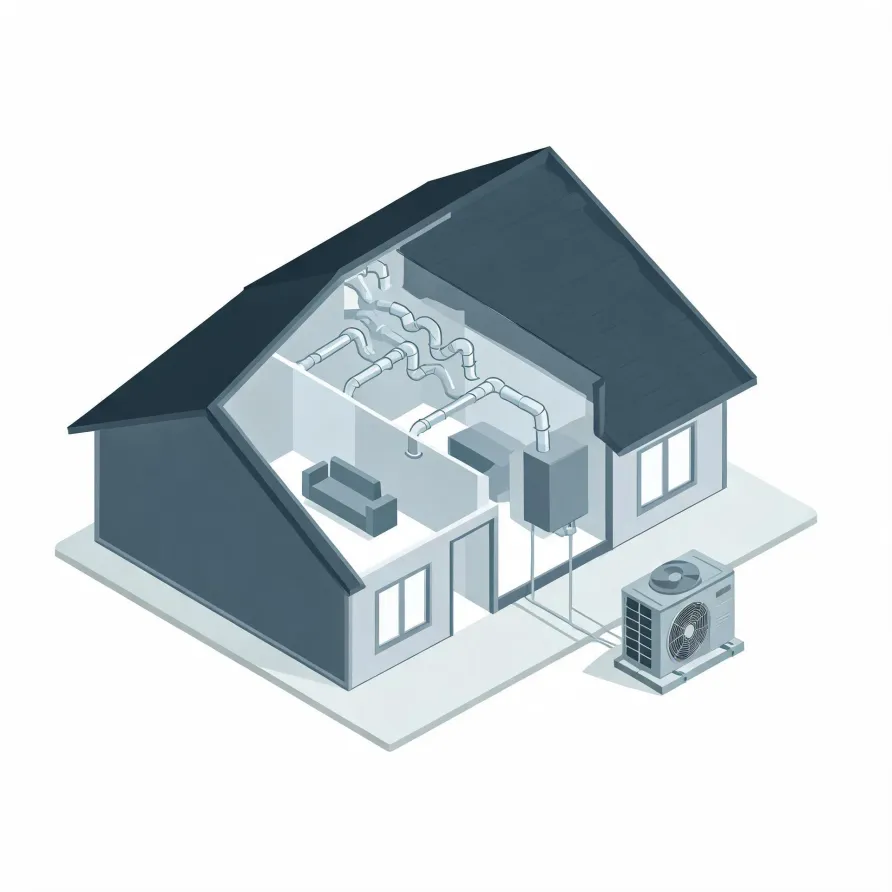
The outdoor unit sits on a pad or bracket outside the house and holds the compressor and coil that do the system's core work. Inside, an air handler or wall-mounted head unit delivers conditioned air to the living space. Each indoor unit connects to a specific zone, so a contractor positions them where the house layout calls for coverage.
A refrigerant line set runs between the outdoor and indoor units, carrying the fluid that moves through both sides of the system. A condensate drain line runs from the indoor unit to a suitable discharge point. The thermostat or control panel mounts on an interior wall and gives the household a single point to manage the system.
The drawing shows a typical layout, and a licensed contractor determines exactly how these pieces are configured in your home.
Find a contractor in Rutland CountyRutland County, by the numbers
178 severe weather events were recorded in Rutland County, Vermont between 2015 and 2024.
NOAA National Centers for Environmental Information, Storm Events Database, bulk CSV export, events 2015-01-01 through 2024-12-31.Half the homes in Rutland County, Vermont were built in 1969 or earlier (2020-2024 ACS 5-year).
U.S. Census Bureau, 2020-2024 American Community Survey 5-Year EstimatesRutland County, Vermont holds 33,991 housing units (2020-2024 ACS 5-year).
U.S. Census Bureau, 2020-2024 American Community Survey 5-Year EstimatesOwners occupy 75.1% of the occupied homes in Rutland County, Vermont (2020-2024 ACS 5-year).
U.S. Census Bureau, 2020-2024 American Community Survey 5-Year EstimatesCodes & Standards for Heat Pump Work in Rutland County, Vermont2 sourced rules and standards
Licensing and Legal Requirements in Rutland County, Vermont
Vermont splits the trade across two specialty licences and a contractor may hold one without the other: field A1 covers automatic gas or oil heating including geo-thermal and ground source heat pumps, and field C3 covers refrigeration or air conditioning including air-to-air heat pumps.
Vermont reaches HVAC work through its electricians’ licence rather than an HVAC licence, and the requirement stops at the front door of a house: anyone performing electrical work in Vermont must be licensed as an electrician unless the work is in a residential building containing two or fewer dwelling units.
Weather Stress on HVAC Equipment in Rutland County
How hard a heat pump works over its lifetime is shaped by what the climate throws at it. Rutland County's weather record is part of what a contractor weighs when sizing and installing equipment here.
178 severe weather events, 2015–2024. Source: NOAA National Centers for Environmental Information, Storm Events Database.